Monday, May 17, 2010

Polyair Ebubble and Oxo-Biodegradable program taking North American market by storm!


Sustainable packaging: Kodak launches new environmental symbol for brand


From Packaging Digest, 5/17/2010 11:34:52 AM
A green and yellow leaf is now starting to help educate customers about the environmentally oriented benefits of KODAK Products and Services, and to promote the company’s commitment to sustainability, says the company.

Kodak is beginning to attach this green and yellow leaf logo to marketing and advertising materials and packaging that include claims that directly address environmental improvements or programs unique to Kodak. Examples include environmental product attributes that result in unique value propositions, services that help customers manage their environmental footprint, recycle and reuse programs, and initiatives that seek to educate customers and the public about Kodak’s commitment to environmental responsibility.

The new leaf logo, for example, now appears in claims relative to the KODAK Adaptive Picture Exchange, a retail photofinishing system, uses no water, produces no chemical waste, consumes 70-90% less energy than comparable traditional minilabs.

The KODAK Printer's EnviroServices Program has also qualified to carry the leaf logo. This multi-faceted program, which includes recycling and reuse options designed to help customers in the printing industry manage their environmental footprint, prevented 20 million pounds of waste from being sent to landfills in 2009.

“We recognize that customers want to know about how companies are being responsible stewards of the environment, and how companies can help them to be better stewards themselves,” said Charles Ruffing, Director, Health, Safety, Environment and Sustainability. “Our new environmental branding logo will help us in speaking with our customers about how we can work together towards these mutual goals.”

The logo will also appear in tandem with the tagline “Kodak Cares” in communicating about corporate sustainability and environmental initiatives.

“But we won't be putting this logo just anywhere,” said Ruffing. “First and foremost, we want our products to carry the recognition of objective and respected third parties like the ENERGY STAR program, whenever possible. Only for those products that aren't covered by one of these programs will we consider applying our new leaf design.”

To highlight its sustainability initiatives, Kodak has launched a new sustainability website: kodak.com/go/sustainability – which broadly addresses Kodak’s policies and performance from the perspectives of innovation, stewardship and responsibility.

“Kodak recognizes that being a successful company and a company that contributes to the advancement of society should be viewed as not just compatible, but complementary goals,” said Ruffing. “Kodak has a long-standing commitment to sustainability, and we are eager to have conversations with our customers and others about how we can become partners in better stewardship of the world’s resources.”

On a related note, Kodak will soon be reporting on progress toward its latest set of goals in the area of environment and sustainability. The company has had such goals in place since 1998, with the current Sustainability Goals covering the areas of Social Responsibility, Product Responsibility, and Operational Responsibility.

SOURCE: Kodak

Saturday, May 15, 2010

A smarterpackaging exclusive from Marketwatch:The second debt storm


Who will bail out the countries that bailed out the world's corporations?

By Alistair Barr, MarketWatch

SAN FRANCISCO (MarketWatch) -- The financial crisis never really went away.

The debt mountain that brought down some of the world's biggest banks and dragged the international financial system to the brink of disaster has simply shifted to governments. Now it's threatening countries around the globe -- and, if left unchecked, could rip the very fabric of Europe's economic system and wreck economic recoveries in the U.S., China and Latin America.

SPECIAL REPORT
The second debt storm
The financial crisis has shifted the debt burden from banks to governments, alarming investors around the globe.

Sovereign Debt
The impact on markets has been severe. The euro has slumped more than 12% against the dollar since the sovereign-debt crisis flared in southern Europe. Gold has marched to new highs as investors seek a safe haven and, perhaps most alarming, it is now more expensive to buy insurance against national default than it is to insure against corporate failure.

"The sovereign-debt crisis spun out of control in the past week, and we see no easy way to resolve it," said Madeline Schnapp, director of macroeconomic research at TrimTabs Investment Research.

Some investors and analysts are increasingly concerned that governments may be no more capable of repaying their debts than the banks and insurance companies they saved. And, they warn, if a major country comes close to default, it could trigger a financial meltdown that would eclipse the panic that followed the bankruptcy of Lehman Brothers in 2008.

The world has seen sovereign debt crises before. Latin America, Africa and Asia have all experienced upheavals sparked by excessive debt. These crises were all accompanied by stunted economic growth, inflation and weak stock market returns, which make it even harder to pay off debts. As investors and government officials ponder the current state of affairs, they see ominous signs that the developed world may be facing a similarly bleak future.

"The problem of the western world is that we have too much debt," said Daniel Arbess, who manages the Xerion investment strategy at Perella Weinberg Partners. "Rather than reducing our debt, we've been moving it from one balance sheet to another."

"All we're doing is shifting chairs on the deck of the Titanic," he added.
Europe's bailout

Some governments have started to respond to market pressure, with the U.K. pledging billions of pounds in spending cuts this week. Spain and Portugal also unveiled austerity measures. But the problem is so big that investors remain wary. Check out Portugal's plans.

Stock markets plunged and credit markets shuddered last week on concern Greece and other indebted European countries like Portugal and Spain might default. See the story on market impact.

"What's happened on a corporate level is now happening on a national level. The first nation to experience this is Greece, but other nations will, too," Schnapp said.

To stop Greece's debt troubles turning into a run on the euro and a global stock market rout, the European Union unveiled an unprecedented package of almost $1 trillion in emergency loans, stabilization funds and International Monetary Fund support on Sunday.

In the days that followed, the European Central Bank bought the government debt of Greece and other countries on the periphery of the region's single-currency zone, such as Portugal, Spain, Italy and Ireland, investors said. Such a drastic step has been shunned by the ECB until now. Read about the market response on Monday.

"Temporarily the crisis in terms of liquidity has been averted, but the underlying problem hasn't gone away," Schnapp added. "Giant debt and expenditures by governments are still there."

TrimTabs cut its recommendation on U.S. equities to neutral from fully bullish on Sunday, in the wake of the European bailout.
Protection

The sovereign crisis has been brewing for months.

For much of the financial crisis, investors worried about financial institutions defaulting, rather than sovereign nations. But that pattern has been upended.

In early February, the cost of insuring against a sovereign default in Western Europe exceeded the price of similar protection against default by North American investment-grade companies. That was the first time this had happened, according to data compiled by Markit from the credit derivatives market.

The move "symbolizes how credit risk has been transformed from corporate to sovereign risk, as the solution to the financial and economic crisis was government intervention," Hans Mikkelsen, credit strategist at Bank of America Merrill Lynch, wrote in a note to investors at the time.

Since then, the cost of insuring against sovereign default in Western Europe has climbed further, hitting a record of 169 basis points on May 7.

The European bailout pushed that down to 120 basis points on Tuesday. But that's still more expensive than default protection on North American corporate debt which cost 100 basis points on Tuesday. (In the credit derivatives market, 100 basis points means it costs $100,000 a year to buy default protection on $10 million of debt for five years).
'100%'
Market Edge: Debt Crisis Enters Second Phase

The global debt crisis is in its second stage as governments deal with the debt absorbed from the private sector, and record gold prices have been reflecting these worries, according to SCM Advisors strategist Max Bublitz. Laura Mandaro reports.

While much of the concern has focused on Western Europe, unsustainable government debt is a global problem. And it is developed world governments that are accumulating the biggest debts, not emerging market countries -- a big change from previous sovereign crises.

"Looking beyond the immediate crisis in Europe, I am particularly worried about the next stage involving the U.S., the U.K. and Japan," Xerion's Arbess said.

Debt to GDP ratios in the world's advanced economies will top 100% in 2014, 35 percentage points higher than where they stood before the financial crisis, the IMF estimated last month.

Three percentage points of this increase came from government bailouts of financial institutions, while 3.5 percentage points was from fiscal stimulus. Another four percentage points has been driven by higher interest on government debt and 9 points came from revenue lost from the global recession, according to the IMF.

"Public finances in the majority of advanced industrial countries are in a worse state today than at any time since the industrial revolution, except for wartime episodes and their immediate aftermath," Willem Buiter, chief economist at Citigroup Inc. (NYSE:C) and former member of the Bank of England's Monetary Policy Committee, wrote in a recent note on sovereign risk.

Even though the current epicenter of the crisis is focused on the euro zone, the overall fiscal position of the single currency area is stronger than that of the U.S., the U.K. and Japan, he noted.

"Unless there is a radical change of course by those in charge of fiscal policy in the U.S., Japan and the U.K., these countries' sovereigns too will, sooner (in the case of the U.K.) or later (in the case of Japan and the U.S.) be at risk of being tested by the markets," Buiter said.

Ultimately, these countries face the risk of being "denied access to new and roll-over funding, that is, of being faced with a 'sudden stop,'" he warned.
Economic drag

Once government debt levels approach 100% of GDP, things can get tricky.

That's because a lot of a country's income from taxes and other sources has to be spent on interest payments.

John Brynjolfsson, chief investment officer at global macro hedge fund firm Armored Wolf LLC, illustrated the point with a simple example. With debt at 100% of GDP, interest rates at 3% and real economic growth of 3%, all the extra income collected by a country would be used to pay interest on its debt.

If a lot of government debt is owned by foreigners, like the U.S., the money leaves the country rather than being invested in more productive ways. This dents economic growth.

A study published this year by economists Carmen Reinhart and Ken Rogoff found that, over the past two centuries, government debt in excess of 90% of GDP produced economic growth of 1.7% a year on average. That was less than half the growth rate of countries with debt below 30% of GDP.

"Most lenders realize that once growth disappears, there's little reason to lend more," Brynjolfsson said. "That's because new lending is just going towards paying off old debt, not investment in productive activities."
U.S.

The U.S. government has spent more than $1 trillion bailing out financial institutions like American International Group (NYSE:AIG) and rolling out fiscal stimulus programs to bolster the flagging economy.

In 2009, the government took in about $2.1 trillion in taxes and other revenue and spent more than $3 trillion, according to TrimTabs' Schnapp. The gap, or deficit, is made up by borrowing more money through sales of Treasury bonds and notes.

In coming years, U.S. government debt will exceed 100% of GDP, according to economists at Exane BNP Paribas and elsewhere.

In the next 20 years, if fiscal policies aren't changed, U.S. debt to GDP will exceed 150%, putting the country in the same league as Greece and Portugal, according to recent research led by Stephen Cecchetti, head of the Monetary and Economic Department at the Bank for International Settlements in Switzerland.

And the official data don't tell the whole story, Buiter says.

Fannie Mae (NYSE:FNM) and Freddie Mac (NYSE:FRE) have been the responsibility of the U.S. government since the mortgage giants were placed into conservatorship by the Federal Housing Finance Agency during the financial crisis in 2008, he noted.

Fannie and Freddie's liabilities at the end of last year's third quarter were almost $1.8 trillion, according to Buiter. This equals 13% of U.S. GDP and should be included in measurements of the country's general government debt, he added.
U.K.

The U.K. government committed 850 billion pounds ($1.25 trillion) to bailing out banks including Royal Bank of Scotland (LSE:UK:RBS) and Lloyds Banking Group (LSE:UK:LLOY) and providing guarantees and insurance to the sector, according to the country's National Audit Office.

The U.K.'s debt to GDP ratio will soon reach 100% and could top 200% in the next two decades if fiscal policies aren't changed, according to Cecchetti's research.

The country's new coalition government, which came to power this week, called for 6 billion pounds in spending cuts starting this fiscal year. Bank of England Governor Mervyn King applauded the plan.

"We are still halfway through the world's worst financial crisis ever," King warned. It's "imperative that our own fiscal problems are dealt with sooner rather than later." Read about his comments.
Japan

Japan's government debt to GDP, at over 200%, already dwarfs the U.S. and the U.K., a hangover from its own financial crisis at the end of the 1980s.

"The perfect example of sovereign risk that is contained today but could be dramatic in the future is Japan," Pierre-Olivier Beffy, chief economist at Exane BNP Paribas, wrote in a recent note to investors.

Such high debt levels aren't a problem now because Japanese people save so much and invest a lot of that money in the country's bonds. Financial institutions in the country are also big buyers.

With more than 90% of all Japanese government debt purchased domestically, interest payments get funneled back into the country, helping to support economic growth.

However, Japan's population is getting a lot older. At some point, savers may stop buying government bonds and start spending their money in retirement. If that happens, the government may be forced to pay higher interest rates when it borrows.

Rates on 10-year Japanese government bonds are below 1.4%. So, despite huge debt, interest payments aren't too cumbersome. But if rates climb, that would change with painful consequences.

"Japan, as an economy, has never admitted its mistakes. Twenty years ago they transferred the bad private assets to the public balance sheet, while nominal GDP has gone nowhere for 20 years," Kyle Bass, managing partner at global macro hedge fund firm Hayman Capital, said during an April industry roundtable run by Opalesque Ltd.

"When your biggest holders turn into sellers overnight, what do you do? You have to finance yourself at G7 rates," he added. "If they borrow where Germany borrows at a bit over 3%, they are out of business."

Bass is betting on higher Japanese interest rates, similar to positions that other hedge fund firms including David Einhorn's Greenlight Capital and John Paulson's Paulson & Co. have put on. Read about Einhorn's views.
'Final chapter'

How will all this debt be repaid? Brynjolfsson discusses the three main alternatives.

Developed nations could generate strong productivity gains, while rising exports from their pharmaceutical, technology and financial-services industries could generate better-than-expected income. Combined with "frugality, sacrifice and good fortune," there could be enough money to repay debts, he explained. This may include lower government spending and higher taxes.

Countries could also default, either because they can't pay or won't, Brynjolfsson said. In this scenario, lenders would likely agree to a reduction, or haircut, on the amount of money they're owed -- either voluntarily or after courts impose a settlement.

A third outcome may be inflation, Brynjolfsson said. Sovereign debts would be honored but would be repaid in currency that's worth a lot less than when the debt was sold.

"The sovereign debt problems encountered by most advanced industrial countries are the logical final chapter of a classic 'pass the baby' (aka 'hot potato') game of excessive sectoral debt or leverage," Buiter said.

"First excessively indebted households passed part of their debt back to their creditors - the banks. Then the banks, excessively leveraged and at risk of default, passed part of their debt to the sovereign," he explained. "Finally, the now overly indebted sovereign is passing the debt back to the households, through higher taxes, lower public spending, the risk of default or the threat of monetization and inflation."
Inflation

Brynjolfsson and other investors are in the inflation camp.

One tell-tale sign of potential inflation is that the U.S. Treasury Department is trying to extend the average maturity of its debt from about 48 months to roughly 84 months, Brynjolfsson said.

"That makes me a little uncomfortable and suspicious," he added.

With lots of short term debt, it's hard to inflate the debt away. That's because interest rates should rise quickly to adjust for higher inflation expectations and investors will charge a higher rate when it comes time to refinance the bonds.

But the longer the maturity of government debt, the easier it is for inflation to kick in before bonds need to be refinanced, Brynjolfsson explained.

Berkshire Hathaway (NYSE:BRK.A) (NYSE:BRK.B) Chairman Warren Buffett said this month that he's bearish about the ability of all currencies to hold their value over time because of massive deficits being run up by governments in the wake of the financial crisis.

The U.S. will never default on its debt because the dollar is the world's reserve currency. But the country may print more dollars to repay with devalued currency, he suggested. Check out Buffett's take on currencies and inflation.

The ECB's actions this week added to inflation concerns. The bank has been in the market buying the government debt of Greece and other indebted European countries, according to Brynjolfsson.

Some investors worry this amounts to so-called quantitative easing that could devalue the euro and produce inflation. The ECB says it plans to neutralize the effects of government bond purchases by selling other assets, limiting growth of the money supply.

Xerion's Arbess sees "a round of devaluations of a lot of different currencies."

"That will be accompanied by inflation in the price of non-renewable assets like gold, other precious metals and industrial commodities," he said. "People start to hold on to things that they think will retain value."

Thursday, May 6, 2010

Trendpost from Trendwatching.com:


Read the full trend briefing at Trendwatching.com

Green Credentials
As entire societies have embraced sustainability in everthing as the (only) way forward, and as millions of consumers are now actively trying to greenify their lives, green credentials are an endless source of status. Just witness a substantial subset of consumers already bestowing recognition and praise on Prius and Insight owners while scorning SUV owners.

Consumers' interest in green credentials will lead to even more eco-friendly goods and services sporting bold, iconic markers and design, that help their eco-conscious owners show off their eco-credentials to their peers.

Also count on a massive increase in green stories (as told by consumers): detailed information on (eco-friendly) sourcing, production, ingredients and distribution all represents a potential benefit to consumers who are keen on sharing their green status stories. And the concept is extra attractive for service providers, who often don't have physical products with which to convey their eco credentials.

By the way, what will make green stories even more powerful is the fact that while each individual can ‘do their bit’ on the environmental issues, their actions are going to be wasted unless everybody else does the same. This gives individuals a great excuse to share their stories and to enjoy a status boost from occupying the moral high ground.
For tons of green innovations that bestow eco-status and credentials on their owners, check out the ongoing coverage of eco innovations from our sister-site Springwise, and re-read our ECO-BOUNTY briefing.

Unconsumption
Also, let's not forget about UNCONSUMPTION: For an increasing number of consumers, the mere act of consuming less*, is the greenest status fix of all.
Needless to say that practitioners of UNCONSUMPTION will heavily depend on STATUS STORIES to make their low or no impact on the environment known to others.
For stats on who's joining the UNCONSUMPTION movement, the LOHAS (Lifestyles of Health and Sustainability) site is always a good starting point.

* Whether it's fuelled by recession-induced frugality, unease with the social and ecological consequences, or just fatigue with having to keep up with the consumption rat-race.

Tuesday, May 4, 2010

Sustainability Initiatives Spur Green Packaging Growth


By Jorina Fontelera from Thomasnet.com

Green packaging is on the rise, and experts say this upward trend will continue at least until 2013. Is this the result of consumer demand or brand owners pushing green?

There is no argument between industry insiders that "green" packaging is on the rise. Whether sustainable packaging impacts consumers' buying decisions, however, is still up for debate. Regardless, packaging manufacturers continue to address sustainability issues when it comes to their products.

"Being more environmentally conscious not only gets higher scores at Wal-Mart, but also is simply good for our environment," Jerry Ruud, vice president of sales and marketing for Berry Plastics, tells Entrepreneur Magazine. "Even companies that do not market through Wal-Mart are pushing green packaging concepts. This involves eliminating PVC (polyvinyl chloride) whenever possible, reducing part weights, eliminating additional packaging as well as seeking alternatives to minimize waste throughout the entire supply chain."

According to Ruud, "green" was the top packaging trend in 2008 and, based on industry reports and media publicity, will continue to be in the years to come.

A new study by industry research firm Freedonia Group forecasts demand for green packaging — defined as material comprised of recycled content, is biodegradable or is reusable — to increase 3.4 percent annually to $43.9 billion in 2013. Green packaging growth is anticipated to outpace overall packaging.

Biodegradable plastics are foreseen to have the fastest gains, fueled by increased price competitiveness with conventional resins, rapidly expanding capacity and a lower pricing volatility than petroleum-based plastics, the report says. Enhanced performance properties, brand owners' sustainability efforts and legislative bans on polystyrene are cited as stimulants for growth as well.

Recycled content packaging is expected to grow in line with overall green packaging growth. Plastic recycled content packaging is expected to drive this segment's expansion with the boost in collection volume, the development of food-contact approved resin grades and sustainability initiatives. Counter balancing plastic recycled content packaging's rapid growth is the slow growth of paper recycled content, research shows.

Lastly, reusable packaging growth will be held back by marginal growth for drums, which face competition from intermediate bulk containers (IBC), the report adds. "More favorable prospects are anticipated for reusable plastic containers, IBCs and other reusable packaging types."

Brand owners are pushing for green products, which is quickly becoming something consumers expect. This trend is thus requiring suppliers to create eco-friendly and recyclable packages, or reduce the amount of packaging over all. "Green packaging is currently in vogue and consumer awareness is heightened due to all the publicity," Hui Herskovitz, vice president of Qosmedix, says to Entrepreneur Magazine.

Adds Alison von Puschendorf, director of public relations at packaging solutions provider MWV: "Consumers are more aware of the environmental and social impact of the manufacturing process than ever before. ... Brand owners are now incorporating sustainability into every aspect of the manufacturing and production cycles — ranging from how materials are sourced to how materials are ultimately used."

Of course, just because consumers are aware of package manufacturing's environmental impact doesn't necessarily translate to them choosing a product because its package is more "green." A new report from The Hartman Group (via The Gourmet Retailer) found that "while sustainability-oriented packaging is quickly becoming customer expectation, it is not a primary purchase motivator."

Rather, a product's ingredients influence consumers' perceptions of sustainability and ultimately the reason for purchase. Consumers surveyed in the Hartman report also said that the most sustainable packaging is "no packaging at all." Having recycled or recyclable packaging is another top requested sustainable packaging attribute.

That said, a package's sustainability or lack thereof still has some effect on consumers. A recent poll by Global Market Insights (via FutureGov) showed that Americans cited damaging the environment as the main reason they'd consider a company socially irresponsible.

Although "consumers don't want to forgo luxury items for environmentally-responsible design concepts," says Heather Ratushny, senior manager of product development for Tarte, to Entrepreneur Magazine, they don't "feel comfortable supporting over-packaged goods."

Still companies continue to push for eco-friendly packs or packaging processes. Dell, for example, will eliminate some 20 million pounds of packaging materials over the next four years, InfoWorld reports. The company plans to cut desktop and laptop packaging materials by about 10 percent globally, increase sustainable content in cushioning and corrugate packaging by 40 percent and ensure that 75 percent of packaging components are recyclable by 2012.

This packaging reduction project will save Dell an estimated $8 million and will likely improve its standing in consumers' eyes when it comes to social responsibility. As Ross Reback, executive vice president of Vogue International tells Entrepreneur Magazine, "As the green message becomes even more prevalent, consumers will gravitate to products packaged with a socially responsible commitment."

But where is that green message coming from — the companies and brand owners or the consumers?

Cold Chain solutions solves packaging challenges

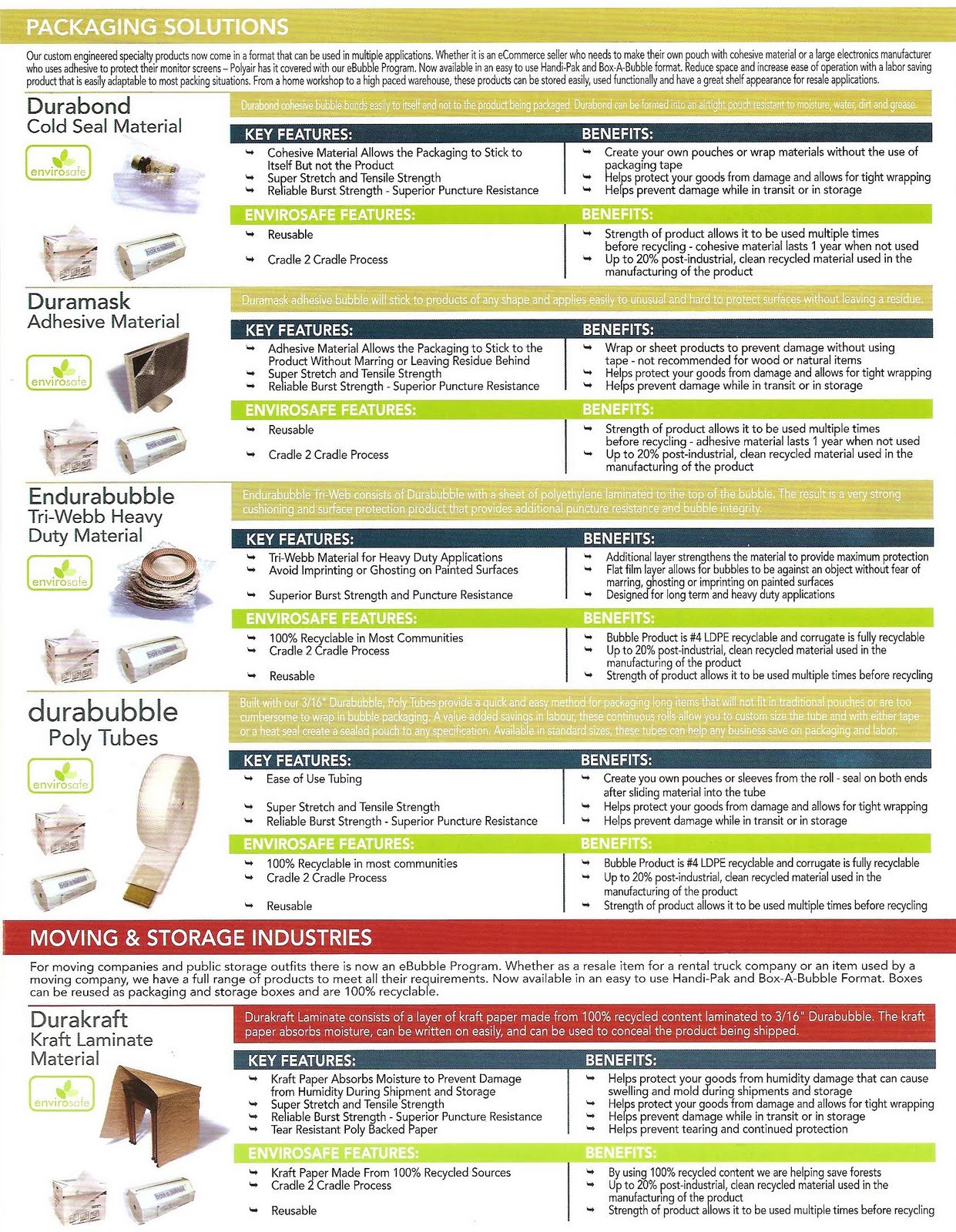
Polyair Launches EBUBBLE program


Please contact your packaging consultant for more information at smarterpackaging@gmail.com

Tuesday, April 13, 2010

Sustainable packaging: Are Americans willing to pay more for “green”?


Mintel research shows consumers continue to buy natural, despite difficult economy.
By -- Packaging Digest, March 25, 2010

According to Mintel’s latest report on green living, the environment remains a concern for the majority of Americans. More than one-third (35%) of survey respondents say they would pay more for ‘environmentally friendly’ products.


“Given this increased interest in the environment over the past few years, nearly every segment of consumer products now offers a “green” option for shoppers,” comments Chris Haack, Mintel senior analyst. “Food and beverage and personal care are the two most mature categories and account for the majority of green products in the marketplace.”

Food and Beverage
After rapid sales growth of more than 24% from 2006-08, the natural and organic food and beverage category saw only slight growth in 2009 (1.8%) as the recession took its toll on nearly every sector of the consumer goods marketplace. Despite this stall, sales in this segment are forecast to grow nearly 20% from 2010 to 2012.

Only 21% of organic food buyers have cut down or eliminated organic purchasing, while 20% have switched to less expensive organic options. Meanwhile, nearly half (48%) are buying as much or more organic food than before the recession. This suggests that organic food is a core lifestyle element for many people who may make cuts in other areas of their budget before they will turn away from organics.

Personal Care
Sales of green personal care products increased by 18% from 2006-08 and similar to food and beverage, saw only a slight incline in 2009 (1.2%). This segment is poised to resume rapid growth once consumer spending begins to recover from the current downturn. One-third of all consumers have never tried organic or natural personal care products, suggesting that there is plenty of room for growth in this market.

According to Mintel’s Global New Product Database (GNPD), new products with an organic or natural claim only encompassed 5% of all beauty and personal care product launches in 2006 but increased to nearly 10% in 2008 and held steady through 2009. According to Chris Haack, “we expect to see a growing trend toward upscale green personal care products targeted to spas, salons and other high-end retail outlets in the coming years.”

SOURCE: Mintel

From product placement to "behaviour placement", Wall Street Journal Investigates


From the Wall Street Journal:

What Your TV Is Telling You to Do

NBC Universal's Shows Are Sending Viewers Signals to Recycle, Exercise and Eat Right. Why?

By AMY CHOZICK

In just one week on NBC, the detectives on "Law and Order" investigated a cash-for-clunkers scam, a nurse on "Mercy" organized a group bike ride, Al Gore made a guest appearance on "30 Rock," and "The Office" turned Dwight Schrute into a cape-wearing superhero obsessed with recycling.

Forget product placement, NBC Universal is trying "behavior placement" with some of its shows. Characters from programs such as "30 Rock" and "The Office" are acting out eco-friendly behaviors that advertisers hope will sway viewers. WSJ's Amy Chozick reports.

Coincidence? Hardly. NBC Universal planted these eco-friendly elements into scripted television shows to influence viewers and help sell ads.

The tactic—General Electric Co.'s NBC Universal calls it "behavior placement"—is designed to sway viewers to adopt actions they see modeled in their favorite shows. And it helps sell ads to marketers who want to associate their brands with a feel-good, socially aware show.

Unlike with product placement, which can seem jarring to savvy viewers, the goal is that viewers won't really notice that Tina Fey is tossing a plastic bottle into the recycle bin, or that a minor character on "Law and Order: SVU" has switched to energy-saving light bulbs. "People don't want to be hit over the head with it," says NBC Universal Chief Executive Jeff Zucker. "Putting it in programing is what makes it resonate with viewers."

TV has always had the ability to get millions of people to mimic a beloved character. Ever since Carrie Bradshaw on "Sex and the City" stopped in at the Magnolia Bakery, fans of the show wait in long lines for the once-quiet shop's $2.75 cupcakes. When Jennifer Aniston as Rachel on "Friends" cut her hair, salons across the country reported requests for the shaggy, highlighted, layered look known as "the Rachel."

This is the power of persuasion that NBCU hopes to tap. "Subtle messaging woven into shows mainstreams it, and mainstreaming is an effective way to get a message across," says Lauren Zalaznick, president of NBCU Women & Lifestyle Entertainment Networks, which oversees the effort.

Since fall 2007, network executives have been asking producers of almost every prime-time and daytime show to incorporate a green storyline at least once a year. The effort now takes place for a week in April and November. Starting April 19 this year, 40 NBC Universal outlets will feature some 100 hours of green-themed programming, including an episode of the Bravo reality series "Millionaire Matchmaker" in which a 39-year-old tycoon with an eco-friendly clothing line goes into a rage after his blind date orders red meat.

NBC's Behavior Placement

30 Rock
The Message: Small changes can reduce your carbon footprint.

What Viewers Saw: Kenneth, the page, is put in charge of reducing the carbon footprint of fictional late-night show "TGS" by 5%. Liz Lemon, Tina Fey's character, reluctantly gives up her office mini-fridge.

The Office
The Message: Get rid of plastic water bottles in the workplace.

What Viewers Saw: Employees complain about metallic-tasting reusable water bottles. "We weren't on theme, we were just on comedy," says Paul Lieberstein, an executive producer.

Top Chef
The Message: Organic, locally grown foods are better for the environment.

What Viewers Saw: Competing chefs prepare a meal for the farm workers at Blue Hill farm using organic, local fruits, vegetables and other ingredients.

In June, NBCU plans a week in which programming will emphasize healthy eating and exercise: The idea is that viewers will watch the shows and then spring into action. "It's about incorporating a marketer's message into a thematic environment," says Mike Pilot, president of sales and marketing at NBC Universal.

While the network says it tries to incorporate green programming throughout the year, the special emphasis twice a year creates an "event" that provides opportunities to advertisers, an NBC spokeswoman says. For instance, a Wal-Mart ad focusing on locally grown produce ran this past November after an episode of the medical drama "Trauma" in which emergency medic Rabbit rescues a window washer dangling precariously from a building; medics are alerted to the situation by a man sitting in his hybrid vehicle.

Behavior placement gives marketers extra incentive to advertise at a time when digital video recorders equip viewers with an unprecedented ability to skip commercials, says Jason Kanefsky, a media buyer at Havas's MPG. "You're not forcing your way into a program in any shape or form," he says. "You're just nodding your head at a program." ABC, CBS and FOX have plenty of product placement but haven't taken the step into behavior placement, network spokesmen say.

TV writers and producers are less enamored with behavior placement. Already on the hook to create holiday-themed episodes and accommodate marketers in other ways, some producers and writers grumble about additional demands. Requests for green-themed storylines come at the start of the year when programming executives sit down with producers and lay out which company-wide themes and holidays they will be working into shows.

Producers do have some leeway. "The Office," for example, embraces Valentine's Day, Halloween and Christmas but refuses to incorporate Easter since it isn't part of office culture.

Angela Bromstad, president of primetime entertainment at NBC, says her only specific request is that writers incorporate something related to the environment into a storyline and not make it a throwaway line of dialogue. "We haven't had any pushback," she says.

Paul Lieberstein, an executive producer on "The Office" who also plays the character Toby Flenderson, says he was thinking about making Dwight a superhero called "Recyclops" before network executives ordered up an environmental storyline.

"In this case it fell right into the realm of what we do," Mr. Lieberstein says. "We'd have to say no if it hurt the integrity of the show."

"Heroes" creator Tim Kring says behavior placement is easier than incorporating a specific brand, which is what the science-fiction series about ordinary people with superhuman abilities, recently did for sponsor Sprint Nextel Corp. This past fall, members of a carnival loaded a pickup truck with recyclables as Masi Oka, in the role of Hiro Nakamura, talks about giving back to the Earth. "Someone has to pay for our big, expensive television shows," Mr. Kring says.

Armed with its own data showing consumers are wiling to spend more if a brand seems eco-friendly, NBC in 2007 launched "Green Week," the programming component of a larger "Green is Universal" corporate campaign. That effort brought in an estimated $20 million in advertising revenue from 20 sponsors, according to industry estimates. Many new clients, including the nutrition bar Soy Joy, came on board, NBC says. In April 2008, the network added another week of green-themed programming, when network logos go green and on-air promos tout NBC's support for the environment. But there are no obvious cues to alert viewers to the green emphasis in programming.

To court advertisers targeting specific demographics, NBC researchers conduct regular focus groups. Viewers are broken into categories based on their favorite shows and their level of concern about the environment. "Alpha ecos" are mostly women who drive hybrids, eat organic and watch the Bravo channel. "Eco-logicals" are older viewers who have "traditional Midwestern values," drink Diet Coke, drive domestic cars and love basic-cable channel USA. When PepsiCo Inc.'s Sun Chips brand launched a compostable chip bag, executives wanted to reach young, edgy consumers who watch "30 Rock." Pepsi purchased a skit starring Kenneth, the show's lovable page. It will run during a commercial break of an eco-friendly episode this fall. "This audience has a tendency to be a little more cynical about blatant product placement," says Gannon Jones, vice president of marketing for PepsiCo's Frito-Lay unit.
Product placement on TV dates back to early soap operas sponsored by Procter & Gamble Co. Programming has been trying to get across messages, like Don't Smoke or Say No to Drugs, for almost as long. In the 1970s, libraries nationwide saw a spike in interest after the "Happy Days" character Fonzie got a library card. Last year, a character in the top-rated telenovela on NBC Universal's Telemundo, "Mas Sabe el Diablo" ("The Devil Knows Best"), had a job recruiting Latinos in New York City to participate in the 2010 Census. (Telemundo voluntarily took on the message for a group that is historically undercounted. It ran its efforts by Census authorities to make sure it had the details right.)

The messages NBC gravitates toward tend to be fairly innocuous. For instance, climate change may be controversial, but people can agree that taking care of the environment is a good thing. Same with diet and exercise: It may be controversial to ask people to quit smoking but people don't argue with taking better care of your body.

Still, do viewers really want their TV sets reminding them to recycle and go to the gym? Executives say the more seamlessly integrated the behavior is, the less it feels like the show is trying to manipulate. "The last thing you want to do is not reach the audience in the right way and make them mad at you," says NBCU's Ms. Zalaznick. Viewers don't mind if "you do a little good in the world, and you're still making your show."

For its first televised ad campaign, Vermont-based cleaning product manufacturer Seventh Generation Inc. paid NBCU to use Tori Spelling and Dean McDermott, stars of Oxygen's reality series "Tori and Dean: Home Sweet Hollywood," in a vignette about organic gardening that will run later this month during a commercial break. The corresponding episode will feature the couple gardening and composting. Dave Kimbell, Seventh Generation's chief marketing officer, says the company doesn't use product placement but sees behavior placement as a more effective way to express the brand's values and "create a dialogue" with consumers.

The trick is to not turn off viewers by being lectury or too obvious, producers say. "Late Night with Jimmy Fallon" had a segment that urged viewers to turn off their lights for five seconds to conserve energy. But each time the lights went out in the studio, a Latina janitor screamed "Ay dios mio!" and a gunshot went off killing a member of the Fallon cast. "At that hour people just want to laugh and have fun. They don't want to be preached at," the host says.

Monday, April 12, 2010

Smarter Packaging follows this website for new ideas


"www.trendwatching.com is full of new trends and ideas and also produces a monthly newsletter definitely worth reading"- smarter packaging